
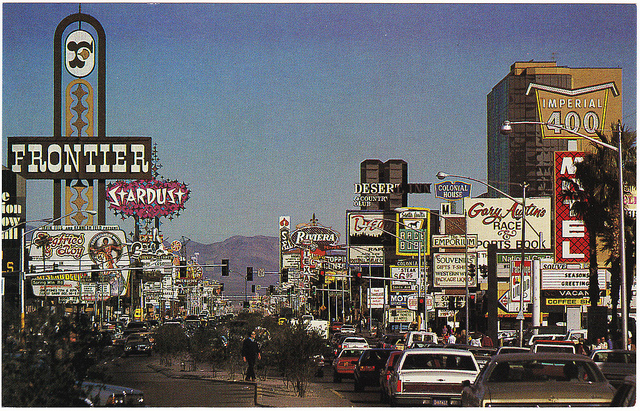
Many Hollywood stars were welcomed to the grand opening, and El Rancho Vegas quickly ended up being a popular hotel amongst film stars. Starting a trend that continues today, each new property tried to do better than existing hotels in elegance and splendor. Las Vegas would soon be America’s play area. Las Vegas presented itself during the 1940s as a town that integrated a Wild West frontier atmosphere with glamour and excitement. Throughout the years, the city was a popular spot for Hollywood celebrities. The Hollywood connection provided the town with a glamourous reputation, as did the mob connection, which became obvious when well-known Mafia gangster Bugsy Siegel constructed the Flamingo Hotel, a tropical paradise and a real classy place. While the Strip was getting bigger with the construction of major hotel resorts like the Frontier, Bugsy’s Flamingo, and the Thunderbird, Downtown Las Vegas introduced new hotels such as the El Cortez and hotel casinos like the Golden Nugget.
Las Vegas started the 1950s as a city (no longer a frontier town), with about 50,000 residents. Hotel development was incredible, with famous names like the Sahara, the Dunes, the Sands, and the Tropicana all acquiring fame with their neon lights. The Desert Inn, which opened in 1950 with headliners Edgar Bergen and Charlie Mc, Carthy, brought the atmosphere of a country-club (including an 18-hole golf course and tennis courts) to the Strip. In 1951, the Eldorado Club Downtown became Benny Binion’s Horseshoe Club, which would become popular as the home of the annual World Series of Poker. In 1955, the Cote d’Azur, which was modeled after the Riviera ended up being the ninth huge hotel to open on the Strip.
Liberace, among the most popular names in program company, was paid the enormous sum of $50,000 a week to perform before audiences in the Riviera’s classy Clover Space. Elvis performed at the New Frontier in 1956 but didn’t attract a large crowd; his fans were too young to fit the Las Vegas traveler mold. In 1958, the $10-million, 1,065-room Stardust upped the stakes imported the well known Lido de Paris phenomenon from France. It turned into one of the longest-running shows ever to play Las Vegas. Two performers whose names have actually been associated with Las Vegas since, Frank Sinatra and Wayne Newton, made their debuts at the Stardust.
The Main Principles Of Hotels On The Las Vegas Strip
In the 1950s, the wedding industry assisted make Las Vegas among the country’s most popular places for getting married. Star wedding events of the 1950s that triggered the trend included vocalist Penis Haymes and Rita Hayworth, Joan Crawford and Pepsi chairman Alfred Steele, Carol Channing and TELEVISION officer Charles Lowe, along with Paul Newman and Joanne Woodward. On a sadder note, the ’50s likewise started the atomic age in Nevada, with nuclear screening occurring simply 65 miles northwest of Las Vegas. A frightening 1951 photo shows a mushroom-shaped cloud from an atomic bomb test noticeable from Fremont Street.
The very first month of the 1960s saw a major event in entertainment history when the Sands hosted a 3-week “Top Meeting” in the Copa Room that was presided over by “Chairman of the Board” Frank Sinatra, with his Rat Pack friends Dean Martin, Sammy Davis, Jr., Peter Lawford, and Joey Bishop (all of whom were in town recording Ocean’s Eleven). The series of programs assisted to form the Rat Load legend in Vegas and, in lots of methods vice versa, making the town hip and cool, the ultimate ’60s swinging retreat. It required the help. After nearly a years of almost constant structure and growth (no less than 10 significant resorts opened in the 1950s), a crackdown on the Mafia and its money, which had actually fueled the city’s advancement, brought building to a halt.
Perhaps trying to show that the mob was opted for great, Las Vegas became a family location in 1968, when Circus Circus burst onto the scene with the world’s biggest long-term circus and a “junior casino” featuring dozens of carnival midway video games on its mezzanine level. Elvis officially ended up being part of the Vegas legend with the release of the film Viva Las Vegas in 1964, which not only furthered the city’s “cool” ratio however also provided it a long-lasting theme song that remains a part of the city’s identity more than 60 years later. But it was not until 1969 that the King’s place in Sin City history would be cemented with his victorious return to Las Vegas at the International’s showroom with a series of concerts that made him one of the city’s all-time famous entertainers.